


admin:Date:2026-03-04Hits:0
1. Overview and Core Characteristics of PVC Film
Due to the flexibility of its formulation, PVC film can transform between soft, semi-hard and hard states. By adjusting the amounts of plasticizers and stabilizers, it can meet different application requirements. Polyvinyl chloride (PVC) film, as a typical "formula-driven" product, its characteristic changes are entirely dependent on the flexible adjustment of the formula. Through precise control of the amounts of plasticizers and stabilizers, PVC film can switch freely between soft, semi-hard and hard states, thereby giving rise to various processing paths such as calendering, blow molding, lamination, and extrusion. These processing choices not only determine the final form of the product, but also profoundly influence its application scope and market positioning.
•Mechanical properties and chemical resistance
PVC films exhibit a wide range of mechanical properties and chemical resistance, suitable for various environments. However, the usage temperature is limited, and attention should be paid to chemical compatibility. Soft PVC films demonstrate excellent flexibility and elasticity, with an elongation rate of up to 200 to 400%, while the tear strength remains at 40 to 80 kN·m⁻¹. They have a soft touch, similar to rubber. On the other hand, hard PVC films are renowned for their excellent tensile strength and rigidity, with a tensile strength range of 50 to 70 MPa and an elastic modulus of 2,500 to 3,000 MPa. Their rigidity is almost comparable to that of PS. This wide range of mechanical property adjustments enables PVC films to meet various application requirements. At room temperature, PVC films exhibit tolerance to NaOH at a concentration lower than 20%, HNO3 at 50% concentration, and H2SO4 at 90% concentration. They also show stability against alcohols and aliphatic hydrocarbons. However, it should be noted that they may be swollen by ketones, esters, and THF, etc.
•Temperature and Flame Retardancy
PVC materials have excellent flame retardant and self-extinguishing properties. For soft PVC, the operating temperature should not exceed 45℃, while for hard PVC, the upper limit temperature is 60℃. It should be noted that when the temperature exceeds 100℃, PVC will decompose and release HCl. Therefore, a heat stabilizer must be added to ensure its stability. When this material burns, the lower end of the flame appears green and releases irritating HCl gas. In addition, the density of PVC is greater than 1, and this physical property also provides a basis for its identification.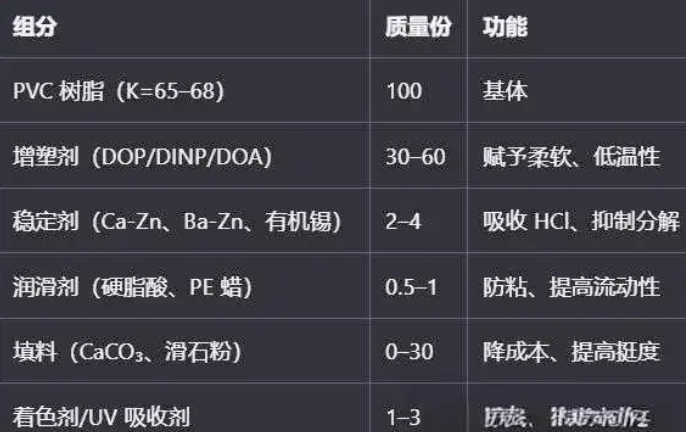
2. PVC Film Formulation and Environmental Trends
•Environmental Plasticizers and Market Alternatives
Phthalate-free plasticizers replace traditional phthalates, and Ca-Zn stabilizers replace lead salts. The market is gradually shifting towards environmentally friendly formulations. As environmental requirements become increasingly strict, phthalate-free DINP, DOTP, and phthalate ester plasticizers are gradually becoming the new favorites in the market. At the same time, the non-toxic Ca-Zn stabilizer is favored due to its environmental advantages. Its usage rate has significantly increased in regions such as the EU and China, even exceeding 70%. This is attributed to the regulations in the EU and China that prohibit the use of lead salts.
3. Main production technologies
•Lamination method, blow molding method, calendering/flowing process
Each process is suitable for different types of films and applications. The lamination method is used as the main thick film production method, the blow molding method is suitable for lightweight film production, and the calendering/flowing process is used for transparent sheet materials. The process flow includes high-speed mixing, mixing or twin-roll plasticizing, four-roll calendering, stripping cooling, and winding. The product thickness is controlled between 0.05 and 0.5 millimeters, with a line speed of 60 to 120 meters per minute, and the width is 2 to 3 meters. The advantages of this production method lie in its high output, uniform thickness, and high surface glossiness, and it is particularly suitable for producing "sign fabric, greenhouse film, credit card base" and other products. Using the upward blow or horizontal blow process, the melt temperature is controlled between 170 and 185 degrees Celsius, and the blow-up ratio is maintained within the range of 2 to 3. The product thickness is between 0.02 and 0.15 millimeters, with the characteristic of low equipment investment cost, and it is particularly suitable for producing "raincoat film" and "packaging tube film" and other products. Using a planetary extruder, passing through a T-shaped mold, and then through the calendering roller for bidirectional stretching, achieving a stretching ratio of 2 to 3 times, thus obtaining transparent sheet materials with a thickness of 0.1 to 0.6 millimeters.
4. Application Areas and Limitations
•Applications of soft, semi-rigid and rigid membranes
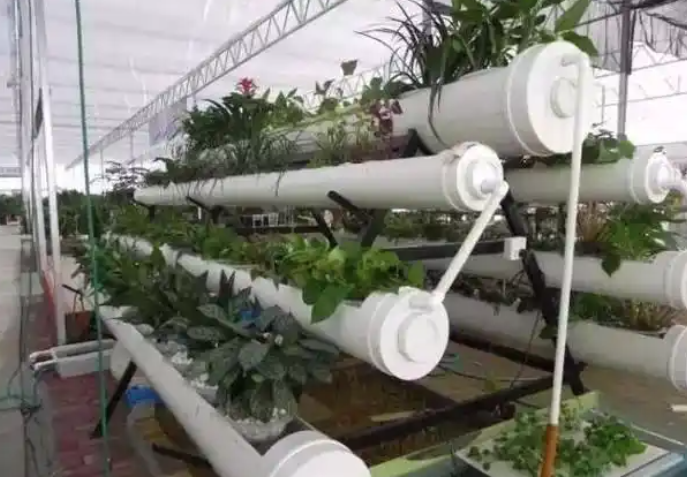
Soft membranes are used in agriculture and industry, semi-rigid membranes in packaging and pharmaceutical fields, and rigid membranes in cards and trays. Each of them faces different challenges and limitations. Transparent sheets produced by calendering/extrusion processes have wide applications in various fields. For example, they are often used in the manufacturing of high-end products such as heat-formed medical trays and yogurt cups. However, this process also has certain limitations, mainly influenced by factors such as equipment cost, technical difficulty, and raw material selection. Soft membranes are widely used in greenhouses, with a light transmittance of up to 85%, and also have good thermal insulation properties, being 2-3℃ higher than PE materials. Additionally, it can be used as a waterproof membrane. In industrial applications, soft membranes also have great potential in the industrial field, such as manufacturing raincoats, shower curtains, for wire wrapping, advertising light box fabric, and pool cover fabric, etc. Semi-rigid membranes are often used for the packaging of chilled goods in supermarkets, but have been gradually replaced by PE co-extruded membranes in recent years. Rigid membranes/plates have important applications in areas such as credit card and ID card cores, heat-formed food trays and mooncake trays, but it is necessary to use a composite PE layer to solve the "chloride ion migration" problem.
5. Market Size and Trends
•Global Market and Expected Growth
The total market volume of PVC film in 2023 was 18.4 billion US dollars. In the coming years, environmentally friendly formulations will grow rapidly and gradually penetrate the market. The global production of PVC film in 2023 was approximately 39,000 tons, with a total value reaching 18.4 billion US dollars. Among them, China accounted for 48% of the share, Europe and India accounted for 17% and 9% respectively. Among various types of films, the annual compound growth rate (CAGR) of extruded film was only 1.8%, which was lower than the growth rates of PE and PP films. However, the market growth rate of "no phthalates, no lead" environmentally friendly films reached 6-7%, and it is expected that its market penetration rate will increase to 35% by 2026. From the downstream application fields, the construction and advertising industries are the largest consumer sectors of PVC film, accounting for 42%, followed by the agricultural sector, accounting for 21%.
Although PVC films are renowned for their excellent chemical resistance, flame retardancy, and adjustable rigidity and flexibility, issues related to their thermal stability and the migration of plasticizers still need to be addressed. With the gradual implementation of environmental regulations such as lead-free and phthalate-free, the demand in the high-end market (such as pharmaceuticals, cards, advertising, etc.) will remain stable, while the one-time food packaging sector may gradually be replaced by PE and PP films. In the short term, the total market volume of PVC films will maintain a slight increase trend, but the market structure will upgrade towards a more environmentally friendly and green direction.
Copyright 2019 Jiangyin Film-Maker Plastic Co., Ltd.